Wednesday, April 29, 2015
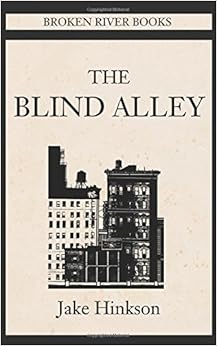
JAKE HINKSON'S THE BLIND ALLEY
Jake Hinkson's new book on film noir, THE BLIND ALLEY, is terrific. It's a collection of essays on cinematic noir, and it's compulsive reading. I wrote a review of it for the new great crime website The Life Sentence. Take a look here.

Monday, March 23, 2015
The Mongolian Conspiracy
And what about Mexican crime fiction? I'm starting to read more
crime novels set in Latin America, and one I read recently that stands
out is The Mongolian Conspiracy, by Rafael Bernal. It's set in Mexico City, and even though it was written in 1969 and takes place
during the height of the Cold War, its view of Mexican politics remains
as relevant as ever. It's also mordantly funny. A great read overall.
I wrote a piece about it for Criminal Element, which is right here: The Mongolian Conspiracy.
I wrote a piece about it for Criminal Element, which is right here: The Mongolian Conspiracy.
Thursday, March 5, 2015
Brothers on the Road
When a writer really knows his characters and their world,
when he knows his people and their milieu inside and out, a novel can’t help
but be a strong one. Assuming the writer has talent and craft. Mike
Miner has both, and in Prodigal
Sons he has put his skill,
experience, and imagination to use to write a calm, nuanced book about a family
in crisis.

The book centers around the Flanagans, from
Connecticut. There are three brothers, Matthew, Mark, and Luke, and their
parents. Matthew, the oldest and the wild child of the family, has
moved to Los Angeles. Mark works in the family store. Luke,
the youngest, lives in Boston where he battles with mental illness. In
L.A., Matthew writes scripts, makes a lot of money working on commercials, and
has a beautiful, loving wife and a large home. Everything should be ideal
for him. He has ostensibly made it. Except that he drinks too much.
Way way too much. When his wife leaves him and his boss places him on
leave from his job, Matthew responds by taking to the road and going on an epic
bender, accompanied by a teenage girl he has met named Tomiko. (Their
relationship is sweetly conveyed and not a sexual one). Where else do you
go when you want to cut loose and immerse yourself in debauchery? Las
Vegas. Matthew and Tomiko drive there from Los Angeles, while back in
Connecticut, the Flanagan family meets to decide what to do about
Matthew. He’s gone missing from his LA house, and nobody knows where he
is. When Mark and Luke agree to go out west to find him, everything is
set in motion, and you wonder what Mark and Luke will do if and when they get
to their brother. Will they give him a few brotherly punches in the
mouth, tie him up and drag him to rehab, bring him back home?
Sunday, December 21, 2014
Chronicle of a Death Foretold by Gabriel Garcia Marquez
Did the great Gabriel Garcia Marquez ever write a mystery novel? Sort off, though of course, being Marquez, he wrote a story that's rich and strange and that does some peculiar things with the mystery form. It's his short but remarkable book Chronicle of a Death Foretold, and I wrote a piece about it, looking at it as crime fiction, for the Criminal Element website.
You can check the piece out here: Chronicle of a Death Foretold.

You can check the piece out here: Chronicle of a Death Foretold.
Thursday, December 11, 2014
Guest Blog: Dana King on How a Character Can Evolve
By Dana King

First, it should be pointed out that, while I’m here today
to promote The Stuff That Dreams Are Made
Of, which is the second Forte story, there are two more on my hard drive
that have been ready for several years and will be released over the coming
months. He also has an important “guest starring” role in one of my Penns River
novels, Grind Joint. More people know
him as the badass in Grind Joint than
as someone who needs intervention to be saved in his original story, A Small Sacrifice. What happened to him?
Family issues and the relationships between parents and
children are a common thread in all the Forte books. A divorced father who adores
his daughter, Forte believes he can never be as good a father as one who lives
at home. This makes him prone to transferring his protective nature to some of
his clients, who tend to have a great deal of violence done to them, physical
and otherwise, often with few, if any, consequences. This is a problem for
Forte, who finds himself much more willing to meet violence with violence as
the series progresses, until he eventually crosses the line into what I think
of as prophylactic violence, violence as a preventive measure.

This was never the plan—I always thought of Forte as an Everyman with skills—even after the first four books were written. Then, preparing for his role in Grind Joint, I looked back and saw how he had become darker and less bothered by violence, both done to him and by him. This presented some delicious options to ponder. For instance, in Forte’s books, he has his own version of Spenser’s Hawk, named Goose, to fill what has been called by many as the “psycho sidekick” role. (I don’t think of Goose—or Hawk—as psychos, but that’s the term, and I can live with it. Mouse and Bubba Rogowski, now those are psychos.) Given Forte’s evolution—or devolution, depending on your point of view—the hero of the Nick Forte series is able to serve as the psycho sidekick when he travels to Penns River for Grind Joint, taking the case places his cousin, the cop, can’t or won’t go.
This change also allows the character to have more layers in
the upcoming fifth Forte story, tentatively titled Bad Samaritan, where Goose is more engaged in reining in Forte than
the other way around. The series will have flipped from a hero with a violent
sidekick to a violent hero with the same sidekick trying to act as a governor.
It’s Goose who remains the constant.
Bio Info:
Dana King’s new release, The Stuff That Dreams Are Made Of,
follows the Shamus-nominated A Small Sacrifice, featuring Chicago private
investigator Nick Forte. He also writes a series of police procedurals set in
the economically depressed Western Pennsylvania town of Penns River.
Classically trained, he has worked as a free-lance musician, public school
teacher, computer network engineer, software sales consultant, and systems
administrator. He lives in Maryland with his wife, Corky, and daughter, Rachel.
Wednesday, October 22, 2014
The Mind is a Razor Blade
Kudos to Max Booth. In The Mind is a Razor Blade, his second novel, he could have written a follow up to his debut novel Toxicity by doing more of what he did so well in the first book. Toxicity is a dark but raucously funny crime novel with three or four intersecting plot lines, and as its story jumps from character to character, it gets inside the heads of several people. It is told in the third person throughout. By contrast, The Mind is a Razor Blade is a first person narrative, a novel that locks you from its opening line inside the brain of one man. That he's a man utterly confused, lost, is clear from the get-go. He's disoriented because of memory loss, and since everything in the book is told through his perspective, we're as limited in our understanding of the events happening to him as he is. We look for clues and search for meaning as he does; we try to make sense of the world he inhabits. It's a violent nightmare world that he moves through - a world Hieronymus Bosch would be proud of - and the whirlwind of bizarre incidents has some particular significance for him. What is that significance, though? That's the question the narrator and the reader need answered.

The trope of the amnesiac struggling to find out who he is and why he's so capable of certain actions (killing, for example, like our guy in this book can do easily) is an old and familiar one. But Max Booth gives it fresh life. The Mind is a Razor Blade opens in media res, with the narrator coming to consciousness naked in the woods, lying in the mud, near a corpse marked with bullet holes. Within moments of realizing that he must've killed the dead man, the narrator shoots and kills a cop. All this while he's trying to get his most basic bearings about himself and why he is in such a tense predicament. In its immediacy and noirish mood, the feeling of a mind bursting awake but still befogged, this opening reminded me of the film Memento. But where the author takes his story from this dramatic start goes well beyond mere noir or any one specific genre. Our narrator, later called Bobby, is living in a world that's somewhat futuristic (in a post-industrial, anarchic, dystopian kind of way), but it's a world that also has soul-takers, demons, telekinesis, and spiders that live in people's necks. All sense of civil, organized society seems to have collapsed; every conceivable type of degenerate has full access to the streets. The police may exist, as the first scene showed, but chaos and violence predominate. Destruction, fear, and rottenness are everywhere. And over the entire insane spectacle hovers a chilling and mysterious word, carried by bums on cardboard signs, spoken by others to the narrator, a word that rings in our narrator's head - Conundrae. What is Conundrae? Who is Conundrae? And why do people refer to that name in tones of awe and terror, like the haunted people in a Lovecraft story whispering of the entity Chulthu?
In The Mind is a Razor Blade, Max Booth concocts a tale that is part crime story, part horror novel, part science fiction, part psychological thriller. He fuses these genres effortlessly into a coherent whole, an energetic and engaging work. The pace is brisk; horrific and revolting imagery mix with black humor and moments of surprising tenderness. And through it all, Booth takes a big risk. It's extraordinarily difficult to craft a novel that for most of its length provides few answers to the myriad questions posed. The reader really is in the dark as to the overall shape and meaning of what is happening, though the characters around the narrator all seem to have an inkling, or definite knowledge, of the general pattern. At times, you feel as frustrated as the bewildered protagonist. When will we get some clear answers? you wonder. Why do all those people know something, while I know virtually nothing? Is the narrator in a half-dead, half-alive state, a twilight state like the hanged man's in Ambrose Bierce's "Occurrence at Owl Creek Bridge"? Or maybe he's merely getting closer to death and everything is happening in his mind like we saw happened to the woman Mary in the horror film classic Carnival of Souls. These were among my thoughts as I read, and to be honest, I don't think I've read such a sustained exercise in hallucinatory mysteriousness since reading Iain Banks' great book The Bridge. Razor Blade has a mood and feeling similar to that Scottish masterpiece. It is both visceral and intellectual, and you never get the sense that the author doesn't know where he's taking us. He is the true master of this universe. He's got the chops and the confidence to pull off the prolonged mysteriousness, and he trusts the reader to go along for the ride.
The Mind is a Razor Blade is not as reader friendly as Toxicity. It makes you work harder. Its payoff, ultimately, is bleaker. But what comes across is a person writing what he wants to write, what he feels he must write come hell or high water. And no matter how harsh things get in the world depicted, Booth never slips into despair. His narrator and the small band the narrator connects with have too much energy for that. Friendship is always possible, even love. A joke made in a difficult moment can work wonders. The struggle here, at bottom, is existential: the question is how to survive in a world so degraded, and how to retain some humanity. Fantastical as Booth's world is, it feels oddly enough like our own. All that pain, suffering, and torture, all that madness...How to deal with it? Through his narrator's actions, Booth ventures a tentative answer that seems to be akin to Italo Calvino's in Invisible Cities: "seek and learn to recognize who and what, in the midst of inferno, are not inferno, then make them endure, give them space."
Pick up The Mind is a Razor Blade here.
Sunday, October 12, 2014
Troubled Narrators, Troubled Times
What do these novels have in common?
Ernesto Sabato's The Tunnel
Albert Camus' The Stranger
James M. Cain's The Postman Always Rings Twice
Les Edgerton's The Rapist
They are all first person narratives told by men in prison for murder. Each book has a distinctly existential tone to it, and in each case, the narrator is self-serving and unreliable. Fascinating novels, each one, great examples of prison noir.
I wrote a piece about these books, focusing on Sabato's novel, for the Los Angeles Review of Books. You can read the piece in its entirety here:
TROUBLED NARRATORS, TROUBLED TIMES
Ernesto Sabato's The Tunnel
Albert Camus' The Stranger
James M. Cain's The Postman Always Rings Twice
Les Edgerton's The Rapist
They are all first person narratives told by men in prison for murder. Each book has a distinctly existential tone to it, and in each case, the narrator is self-serving and unreliable. Fascinating novels, each one, great examples of prison noir.
I wrote a piece about these books, focusing on Sabato's novel, for the Los Angeles Review of Books. You can read the piece in its entirety here:
TROUBLED NARRATORS, TROUBLED TIMES
Subscribe to:
Posts (Atom)