Sunday, February 21, 2016

Good Reviews for Graveyard Love

Well, it's been awhile since I posted here so I was thinking this might be a good time to mention what's been going on of late.

The main thing is that my new novel , Graveyard Love, came out at the beginning of February, and I'm happy to say that the reviews for it have been good.


There have been a number of good reviews for the book so far - one from Angel Colon at My Bookish Ways, one from Benoit Lelievre at Dead End Follies, and another from Out of the Gutter Online.

I also did an interview talking about Graveyard Love, the pitfalls of publishing and genre fiction with Benoit Lelievre at Dead End Follies, and I chatted with crime novelist Alex Segura for a talk over at The Los Angeles Review of Books.


It's been a heady and enjoyable couple of weeks.

Now....back to the novel in progress.


Monday, January 18, 2016

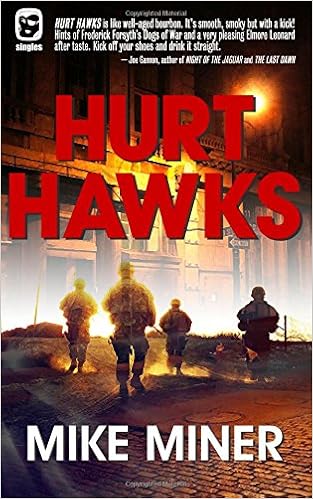
HURT HAWKS by Mike Miner

In his novel Prodigal Sons, Mike Miner captured the many complexities inherent in the dynamic among three adult brothers. In his follow up book, Hurt Hawks, Miner again explores the bonds between a band of brothers, but this time, the fraternal ties are not based on blood. Or, at least, not blood in the familial sense.  When an Afghan War veteran in Dorchester Massachusetts is killed by a local thug who collects shakedown money for the area's local gangster, an ex-soldier whose life the vet once saved calls together his old unit to find out what happened to the vet and who killed him. To say that Captain Patrick Donavan, the unit commander, has led a morally checkered life since leaving the service is an understatement, and in fact none of the members of his old four man unit has had an easy time of it in civilian life stateside. But the chance to reunite for a righteous cause, and to defend the victim's imperiled widow and son, is something that re-energizes these men and makes their lives worth living again.

Hurt Hawks calls upon a number of familiar tropes.  You have a revenge story that wouldn't be out of place in a Western - the way the young boy Andrew looks up to Donovan clearly has echoes of Shane - you have the war vets in a crime story back home trope; you have the morally compromised individual searching for something, a defining act, that will give him a measure, however small, of redemption. What makes Hurt Hawks work is the purity with which Miner tackles his subject manner.  A story doesn't have to be brand new to work if the execution clicks. And here, yes, it clicks. The writing is direct, clear, and fast. Every character in the book, major and minor, is vividly etched.  The tone is serious and morally ambiguous, the narrative compelling. You care quite a bit about what will happen to Patrick Donavan, his crew, and the widow and boy they're defending, and Miner ends things in the best way possible - by following through without false sentiment on the initial premises he laid out.

Mike Miner has a gift for creating real, complicated people on the page, characters with weight, and now that I've read two of his books, it's safe to say I'll pick up quickly whatever he turns out next. 

Hurt Hawks is published by One Eye Press, by the way, which continues to put out really good novellas and short novels.


Thursday, January 7, 2016

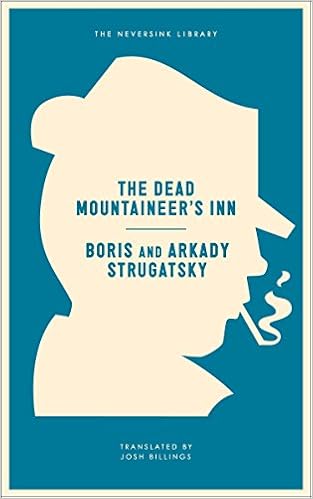
THE DEAD MOUNTAINEER'S INN by Boris and Arkady Strugatsky

Russian science fiction masters the Strugatsky Brothers (Roadside Picnic, Definitely Maybe) wrote one detective novel.  Just that one, but the book is a weird funny ride way more inventive than most mystery novels.  It's subtitled One More Last Rite for the Detective Genre, and, among other things, it is in fact a send-up of the classic locked-room, isolated country house murder mystery.  Well, it's that, and much more. I took a look at the novel over at Criminal Element.


Thursday, October 22, 2015

Can't a Guy and his Kid Read on the Subway without Going Viral?


This innocent enough looking photo of my 10 year old son and me reading together on a New York City subway has gone viral.  Someone took this picture of us on Saturday afternoon, and by Wednesday morning it had led to various threads on Reddit, trending at one point to #1 there.  As of this writing on Wednesday night, it has been viewed over one million times on imgur.com.  All well and good, but the question I was asking myself all day, since finding out this picture was out and attracting so much attention, is why.  What’s the reason for the fuss? We’re only reading, for crying out loud, a father and his kid, something we do on the train quite often, but to judge by the comments on the Reddit threads, something about this picture hit people.  The experience of suddenly finding thousands of anonymous people talking about you and your kid, speculating about you, giving definitive opinions about you, has been surreal to say the least.
            
First off, there have been the people who ask bluntly why this picture is even posted and getting upvoted.  “I don't get it, is reading a book in public something people don't do anymore,” reads one comment, and another says, “How did this manage to reach the front page.. father & son reading wow.. ok?” To be honest, that’s precisely what I would have thought if I’d seen this photo causing a stir on social media.  These people, actually, seem like the sensible ones to me, and I understand if they get a little sarcastic in their tone. But then there are the people who are angry, their anger directed at any number of things. For brevity’s sake, let me try to list the anger points the threads contain:

1) Anger at the photographer for taking the photo at all.  The general thrust here: Can’t people go about their normal business without someone creepily using their phone to snap a shot?

2) Anger at the photographer along racial lines. This is a common one. The photographer took this shot out of an obvious condescension for black people, or as one person says, “It must be the person’s first time seeing black people in the wild reading.”  I lost count of how many people are certain the photographer is a racist. They’re sure he or she posted this out of some, perhaps unintentional, racial intent. Either the photographer’s amazed to see a black man and his son reading or the person’s astounded to see a black father at all with his son: “OMG! A father figure! Quick! Take a picture!  It must be like seeing a unicorn in NYC to see a man of color reading a book AND hanging out with a young child.”  Well, call me a naïve black man, but until I read the comments like these I didn’t give any particular thought to the racial motivations of the photographer.  I figured the person saw two human beings in a specific way that made them appear worthy of a shot. Of course I could be wrong, but…

3) Anger at the people whose views about the photo they disagree with.  These threads mostly consist of people cursing at other people on their thread or cursing at the friend of the photographer who actually posted the picture.

I could go on, but I think you get the idea. And I’m not even getting that deep into the self-styled wits among the commentators, the ones who came up with pearls relating to why we’re only reading books (who does that anymore?) because we can’t afford smartphones to read from, or Kindles.  Ah well, the commentators were entertaining, I can’t deny that, and to watch this little picture open up a world of arguing and dissent pretty much made my day.  My son and I in a photo that served as a Rorschach Test on Reddit. 

The truth is we were just reading.  I happen to love reading, have read since I was a child, and I’m trying to pass that enthusiasm on to my kid.  Anything complicated there?  If he’s into a book and wants to read on the subway – and sometimes, yes, I have to push him to pick up a book – I’ll read my book at the same time as a form of encouragement. Plus, again, I just like to read.  If I’d posted this explanation on Reddit, would anyone have believed me? I’m not sure.

But what do I think the photographer’s intention was?  Since I know nothing about the person, I can only venture a guess.  And I like to go with what’s most straightforward, and most likely.  The person with their phone saw a cute scene, son leaning his head against his father’s shouder, the two reading separate books, and took a quick shot.  As a friend of mine said, the photo sort of says, “Look, there’s hope in the world.”  Probably we’re dealing with a softy at heart, and this softy simply wanted to put out a photo that would warm other people’s hearts. I’ll tell you what: that’s how most of my friends, people who know me, white and black, took the photo, and there were plenty of people on the Reddit threads too who conveyed a basic, “That’s a sweet scene. Don’t read more into it,” in their comments.  So maybe there’s hope after all, even on anger-filled sites like Reddit.  Who knows?  To start the day in normal fashion, unknown to all but family and friends, and end the day as the object of intense speculation among over a million people is enough to make me want to hole up in my house right now and sink into a book.  Not with my son, though. At this moment, it's late at night, and he’s asleep.

Thursday, October 15, 2015

MISSING PERSON by Patrick Modiano

Recently, I got around to reading Patrick Modiano, winner of 2014's Nobel Prize for literature. For awhile now, I've been reading about him, and what I read made me think I would like his books, particularly Missing Person, his 1978 novel that won France's highest literary award, the Prix Goncourt.  A detective story about a man investigating himself, ran one description somewhere, and I was very intrigued.  I'm happy to say my expectations were fulfilled.  I liked Missing Person a lot and decided to write something about it.  It's a piece you can find here: Missing Person. Check it out if you have a few minutes.


Friday, September 11, 2015

Ghost Money by Andrew Nette

Using the thriller or crime novel as a means to explore a particular place and historical epoch can be a precarious business.  On the one hand, there is the danger that the historical detail will overwhelm the narrative's drive and suspense.  We've all read thrillers that get lost in the thickets of period research.  The story's pace slows; the author seems to be letting you know he went to a lot of trouble to gather, study, digest, and regurgitate the information before you.  On the other hand, the thriller author runs the risk of appearing to use a grim setting - Germany under Hitler, the Soviet Union under Stalin - merely for sensationalism and light entertainment.  We get action set against a blithely presented atrocity exhibition.  Actually, I'd rather read the second type of novel more than the first.  At least the pulpy approach can be fun, and the book will probably move fast.  But better than either approach is the seamlessly blended historical crime tale, the one where the researched information is folded into a propulsive, compelling narrative.  It's a blend difficult to pull off, but for the most part, Andrew Nette accomplishes it in his 2012 novel Ghost Money, set in Cambodia in 1996.


The plot is clear and engrossing.  The sister of a shady Australian businessman named Charles Avery hires Max Quinlan, an ex-cop from Australia, to find her brother.  Quinlan himself had a Vietnamese mother and Australian father, making him something of an outsider wherever he goes.  He picks up Avery's trail in Thailand and that trail leads at once to Cambodia, where Avery has apparently been involved in dark business dealings with members of the Khmer Rouge.  Out of power for seventeen years, since arch-enemy Vietnam invaded Cambodia and pushed them out, the Khmer Rouge has remained a potent and fearful force all this time, and they've been surviving by selling timber and mined gems along the Thai-Cambodian border.  By now, however, a significant chunk of the movement has defected and wants to abandon hiding and exile.  Cambodian Co-Prime Minister Hun Sen, himself a former Khmer Rouge member, is open to the possibility. He'll negotiate with them.  So the country sits on edge, at a defining moment in its blood-soaked modern history, when Quinlan arrives to do his investigative work.  

In a country this byzantine, that has a language he doesn't know, Quinlan needs assistance.  He finds it in the form of a Cambodian journalist called Sarin.  Both men carry their traumas with them - Quinlan's are personal (he had an alcoholic father who killed himself; while a cop, his own arrogance got a fellow cop killed), and Sarin's are historical (he survived the horror of Khmer Rouge rule, but he acquired the inevitable mental scars that go with such a survival) - and while dealing with their anxieties and fears, they have to contend with the outside dangers arising from their quest to find Avery.   Whether Western or Cambodian, the man's acquaintances were not exactly polite types, and these people want to track him down as much as Quinlan does.  On every level, from the intimate to the societal, it's a treacherous, hazard-filled world Nette depicts, and reading his book evoked some of the feeling I love to get when reading a novel by Joseph Conrad or Graham Greene. These two were absolute masters at integrating crime and espionage plots into political and historical contexts, and Nette has learned a good bit from them.  Certainly there are echoes of Greene's The Third Man in Ghost Money's plot, and the hunt for the shadowy Avery, leading Quinlan from the man's sister to the dense Cambodian jungle, has a Heart of Darkness vibe.  Two or three times, Nette pauses the narrative flow to fill us in on recent Cambodian history and how the country came to be where it is by 1996, but these sections only serve to enhance the novel.  We need to know what happened in Cambodia during the Khmer Rouge period in order to understand why the characters act the way they do and why the country Max Quinlan travels through is as idiosyncratic, and haunted by ghosts, as indeed it is.  This is a crime novel about people caught up in history and how they adapt or fail to adapt to the burdens and terrors of that history.  Ghost Money is a serious entertainment, and it's well worth any reader's time.


Monday, July 6, 2015

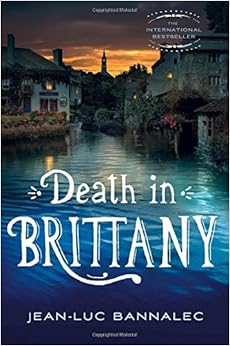
Death in Brittany by Jean-Luc Bannalec

Sometimes in my crime reading I enjoy a little escapism, namely, a traditional mystery.  If it's set in an enticing locale, one I'd like to visit in real life, all the better.  I recently read Jean-Luc Bannalec's debut novel DEATH IN BRITTANY for this type of escape, and the book served its purpose well. I reviewed it for Criminal Element - and it's a piece you can read right here.