Saturday, September 27, 2014

DEADLY DEBUT: Murder New York Style


As a New Yorker, I spend so much time armchair traveling through crime fiction, reading stories and novels set in foreign countries - Britain, Sweden, Italy - or parts of the US where I don't live - Los Angeles, the South - that I sometimes forget what a great crime city my hometown is.  Sounds strange, but it's true.  When I'm looking for a mystery or a noir story to read, I think first of getting away to someplace unfamiliar, someplace that the story will allow me to explore through it.  New York City I see every day, and I don't want to spend too much of my precious leisure time submerged in the familiar.  Still, when it came to Deadly Debut, something about the New Yorker magazine styling of
the cover caught my attention. And the cover announced, "Murder New York Style."  Why not? I thought.  Stay local for a change.  Deadly Debut is a mystery anthology edited by Clare Toohey for the New York/ Tri State Chapter of SISTERS IN CRIME, and I have to say I'm glad I did pick it up.

The anthology contains seven stories written by women and for the most part centered around women. We get stories set in all five boroughs and one even set in Westchester. With each one, it's clear that the author knows her territory.  Each presents a slice of New York you may feel you know but which in fact you haven't quite seen. No overly used spots or neighborhoods among these tales. This gives the whole collection a freshness that is welcome, and as I read, I experienced the pleasant sensation I get when reading fiction set, say, abroad.  I felt, just a little bit, like I was exploring.

Elizabeth Zelvin's "Death Will Clean Your Closet," the first story, takes place in the old neighborhood of Yorkville, on the Upper East Side.  It captures quite sardonically the preoccupations of a certain kind of cramped Manhattan apartment dweller.  Closet space and the thinness of the walls can affect a New Yorker's life very much, and how well do you actually know your apparently innocuous neighbors?  You pass them every day in the hall, and all you may know is that they like heavy metal and cook a lot with garlic.  But if there's more to them than that?  This was among my favorite stories in the collection.

"The Lie", by Anita Page, is a poignant memory piece set in 1949 on the Queens-Long Island border. It's a tale of sad violence that is also about the inevitable change that comes to the area where you grew up. It goes without saying that you can't go home again.

Terrie Farley Moran's "Strike Zone" takes you back to 1961 in the northern Bronx.  It's a complex story told by an adolescent girl less interested in boys than in an author she discovers one summer - Edgar Allan Poe. She lives near the cottage Poe inhabited for years, and the master's tales of murder and obsession fascinate her.  Not coincidentally, she has fantasies of killing a teenage boy who's always hounding her as only teenage boys can.  But how can he not seem insignificant when the only boys who do interest her are Mickey Mantle and Roger Maris, the historic year of their great home run race?  Moran's prose is lucid and quick, and  everything ends on an appropriately chilling, Poesque note.


Overall this is a strong collection, with good variety among the authorial voices, and I'd be remiss if I didn't mention that I also especially liked "Murder in the Aladdin's Cave", by Lina Zeldovich. The Aladdin's Cave is a go-go dancing club, the main character one of the dancers there.  It's an unusual and evocative place to set a mystery, and the murder that occurs there is a variation on the locked room type, always fun.  Zeldovich gives us a colorful cast of characters and suspects, and I had to wonder whether the hip-scarved sleuth Eve Gulnar has starred or will star in other adventures.

Deadly Debut: It's New York, it's crime, and it's entertaining. What more could you really want from a collection?



Tuesday, August 26, 2014

A Movie That Has Grown on Me


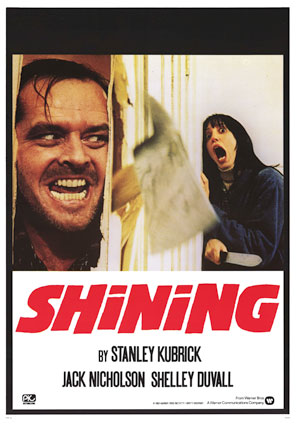
Bryant Park, where I do my film talks series each summer, asked me to write a few words about the last movie of the summer playing in the film festival there this year - The Shining.  What can be said about this movie that hasn't been said, often nuttily, already.....other than, when I first saw it, on its very opening night in 1980, I wasn't thrilled with it.  And yet, over the years, few movies have grown on me as much as Stanley Kubrick's movie has. I first saw it when I was seventeen years old, on its opening day – May 23, 1980.  Never had I been as excited to see a film.  I’d read and loved the novel by Stephen King, which, to this day, I consider a horror masterpiece.  Stanley Kubrick was already one of my favorite directors: 2001: A Space Odyssey, Barry Lyndon, and even A Clockwork Orange (which I saw on HBO) were all movies I’d seen more than once.  When the news had come out that Kubrick was adapting King’s novel, I could barely believe it. The very idea of Kubrick doing a horror film, my favorite genre then, was thrilling, and that he would adapt my favorite horror novel seemed like something I’d dreamt. Then to hear that none other than Jack Nicholson would star in the lead role as Jack Torrance was the icing on the cake.  I knew, positively knew, this would be a film I would see, consider great, and instantly rank among my all-time favorites.

           
It didn’t quite happen that way.  Kubrick’s film makes a number of key changes to King’s book, and when I first saw the movie, these alterations bothered me.  I understood that film adaptations don’t have to follow their source material and sometimes improve upon their source material by making changes, but the book version of The Shining seemed so well-suited to be a movie, I wondered why Kubrick had changed it. Of course I also grasped that Kubrick was being himself, the inimitable and original Stanley K, and that he had chosen the book not to rehash King’s ideas of fear and horror but to develop his own. 


In a nutshell, one could say that King’s book goes for horror that is psychological and visceral.  The characters face both emotional dread and physical fright. And you like and care for these people, including, up to a point, the tormented Jack Torrance, who transforms from troubled but loving father to his wife and young son into homicidal raging monster of a father.  It’s the primal quality of that transformation – father as protector into father as monstrous destroyer – that carries power in the book, and as the tension in the book grows, you are right there with the characters, feeling, at different times, the conflicting emotions of each of them.

            
Kubrick, on the other hand, keeps you at a distance.  He cast Shelly Duval as Jack’s wife Wendy in part because, superb actress though she is, she has an odd, eccentric quality that doesn’t make her “audience-friendly”.  Even Danny Lloyd, who plays their son Danny, has an aloof manner.  The film unfolds in a way that is more like a slow burn than a traditional horror thriller, and this rhythm, even as a Kubrick fan, annoyed me just a bit.  Added to which was the film’s ending, the last scene, something not in the book.  While King resolves the novel with safety and closure, the horror finished (though there will be mental scars), Kubrick’s movie ends on an enigmatic note that left me frustrated.  It didn’t seem necessary.  Why couldn’t Kubrick, for once, just do things in a straightforward way?  I asked myself. He had great horror material yet he directed it to create conundrum upon conundrum, going for creepiness more than real horror.  I’d enjoyed the sardonic notes in the film – vintage Kubrick (and Nicholson) – and liked very much the last forty five minutes, when Nicholson is in full psycho mode pursuing Danny and Wendy, but the lead up to that part and its aftermath left me feeling disappointed.  Still, I couldn’t let it go at that.  This was a Stanley Kubrick film and nobody ever said Kubrick’s films are easy.  You have to wrestle with them. You have to see them two or three times to do them justice.  As I was leaving the theater, mulling over the film, I was certain I’d be seeing it again.  

And I have.  Many times since then, with an appreciation that grew and grew until now I see it as one of the great horror films.  It does indeed build gradually, emphasizing eeriness and disorientation over shocks.  It has an unnerving mood like no other film.  True, you don’t get as emotionally attached to the characters as you do to King’s, but you watch with mounting dread as this small family unit, in chilling increments, implodes.  There has never been a more disturbing portrayal of a writer blocked than Jack Nicholson in this movie, and the scene where Wendy discovers what he has been writing for weeks and weeks instead of his supposed novel is a definite classic.  As with all Kubrick films, the music is effective - dissonant, jarring - and the famous Kubrick tracking shots make the Overlook Hotel seem at once huge and claustrophobic.  By the time Nicholson’s character loses it and starts wielding an axe to kill his wife and son, you are mesmerized and on edge.  The suspense of the last 45 minutes gets your pulse racing.  You may sweat, but you also feel cold.  You feel as if you’re trapped with Danny and Wendy in the snowbound hotel.  And the riddles Kubrick poses, the multiple interpretations possible to explain everything that occurred?  Now, to me, these only make the film seem richer – one reason I can see it over and over.